
By Eileen Legaspi-Ramirez
The following text is an introduction to a joint contribution to the Womanifesto Way Anthology by The O Home, Gantala Press and Eileen Legaspi-Ramirez. To explore this contribution and its relations click here.
Suggested citation: Eileen Legaspi-Ramirez, 'Being Here and Now, Imagining Tomorrow', in Low, Yvonne, Varsha Nair, Roger Nelson, Phaptawan Suwannakudt, Nitaya Ueareeworakul and Marni Williams, The Womanifesto Way, Power Publications, 2026.
‘We deem this womanifesto as a work in progress, like Gantala Press. Any final version lies in the ultimate fate of women in the future.’ 1
This forthright ellipsis appears in Gantala Press’s enduringly unfinished work, its publishing manifesto (also eponymously 'Womanifesto'), which first went public in 2019. Readers today could take this as an avowed sign of life, in all its potent volatility, posed against orthodoxies, even within feminist thought.
To my mind, the serendipitously shared name of Gantala's WIP document and Womanifesto (the Thai-based collective) signals a conjoining at the hip. While the Thailand-reared Womanifesto remains our primary hinge behind this project's becoming, parallel agentive acts of naming and doing make the case for claiming operative affinities. Such claims underpin this positing of lateralities between distanced fields, which span across time and space.
My own scramble for physical and affective sustenance amid cruel COVID-19 lockdowns brought me to Gantala Press's project Makisawsaw: Recipes x Ideas (2019), which paired prescriptive texts on food and politics at a most auspicious historical moment. To this fumbling cook and introvert activist, ‘makisawsaw’ (translating to the call to dip in) literally and symbolically hit at the gut. Being a cancer patient confined at home with laughable cooking skills and limited access to vegan supplies, discovering Gantala felt like finding space to collectively figure and reach out from foisted solace. It was a lifeline in many respects. My decades' dalliance with Womanifesto felt very much like this—a familiar kindredness relished specially under duress, even from afar.
Gantala's Womanifesto calls upon similarly resonant ideas and principles: remoulding, futurity, smallness, collectivity in process (writing, editing, translating), making room for vernacular texts over vetted literature, veering from the nod of institutions and hierarchical structures invested in keeping inequities operative. Like Womanifesto, Gantala has kept itself nimble, shapeshifting as needed, reconsidering tracks they had previously sworn off or maneuvered around—this resonance ultimately lends breadth to their present work, which is encountered by a diverse public.
Early exchanges with Gantala Press's Faye Cura led to surfacing threads of thinking and practice that were akin in tone, material, and process. There was indeed Gantala's publishing manifesto to begin with. I'd also found—among Womanifesto's intimate and intuition-driven exercises, documented in their 'Gatherings'(2020) blog entries during lockdowns—that there had congealed a broad band of earnestly offered invitations to engage. These were quiet but affectively wrought ventures: readings at a courtyard, shared salad recipes, exchanged postcards, passed around drawings, performance-conversations from clipped scripts—each proposition mindful of what could be done in crip time and space, as the pandemic latched onto breath, colour, sound and taste.
Gantala's and Womanifesto's deliberately diminished scale and situatedness, choosing to remain bound to capacity and potency (bookmarked on Mao Zedong in Gantala's case) implicitly privileges process over polish. Making room and deferring to untrained or non-professional makers asserts the value and power of ‘craft’ as embodied and agentive labor that does not merely tend to markets for goods, but is a means to value the self. It is this lived-out-learning from and alongside communities, specifically peasant and labor sectors, that remain key to the artists' own decolonising journeys.
In early February 2020, Gantala, with volunteers for the Rural Women Advocates (RUWA) set up Magtahi ay di biro (sewing/sowing is no joke), a sewing workshop-educational discussion on rice tariffication and its impact on peasants' daily lives. Learning from the Head of the National Federation of Peasant Women (AMIHAN), Nanay Zen Soriano, at this event meant not only learning to blanket stitch, but construing a gendered imaginary of rural landscapes which have been vulgarly skewed by tarrification and inoperative agrarian reform. A month later, right before the onset of the COVID-19 national emergency declaration, they were darning up participation for what would become a shelved exhibition about the ‘un-banning’ of the Valerio Nofuente Collection, which was previously redlined under Ferdinand Marcos Sr.'s dictatorship. The collection contained key material on MAKIBAKA, a National Democratic women's organisation formed under martial law. Gantala had hoped to historically enplace these texts and organisations. With plans scuttled by institutional closures and finding herself forced into close quarters, Cura persisted by making a cloth book on MAKIBAKA along with ideas she had been thinking and working through pre-lockdown.2 Some 'pages' appear here as stitched and tactile enunciations on fabric—a soft membrane presenting a far less ponderous, easier to conceal, and literally lightweight medium that codifies deep seated trauma from violence perpetrated by Rodrigo Duterte (now [in 2026] seeing some magnitude of justice at the International Criminal Court at the Hague). Gantala's iterative collaboration with RUWA in crafting peasant protest banners, specifically for AMIHAN, comes inlaid with constituitive content and philosophical logic. As Cura puts it: ‘We piece together ideas, connecting the scraps of history by narrating the original works and narratives of the women who till the fields.’ It is within this same telling of collective work that she mentions the need for writers like her to be reminded to foreground how peasant women bear the brunt of oppression, both from within and beyond the movement.3
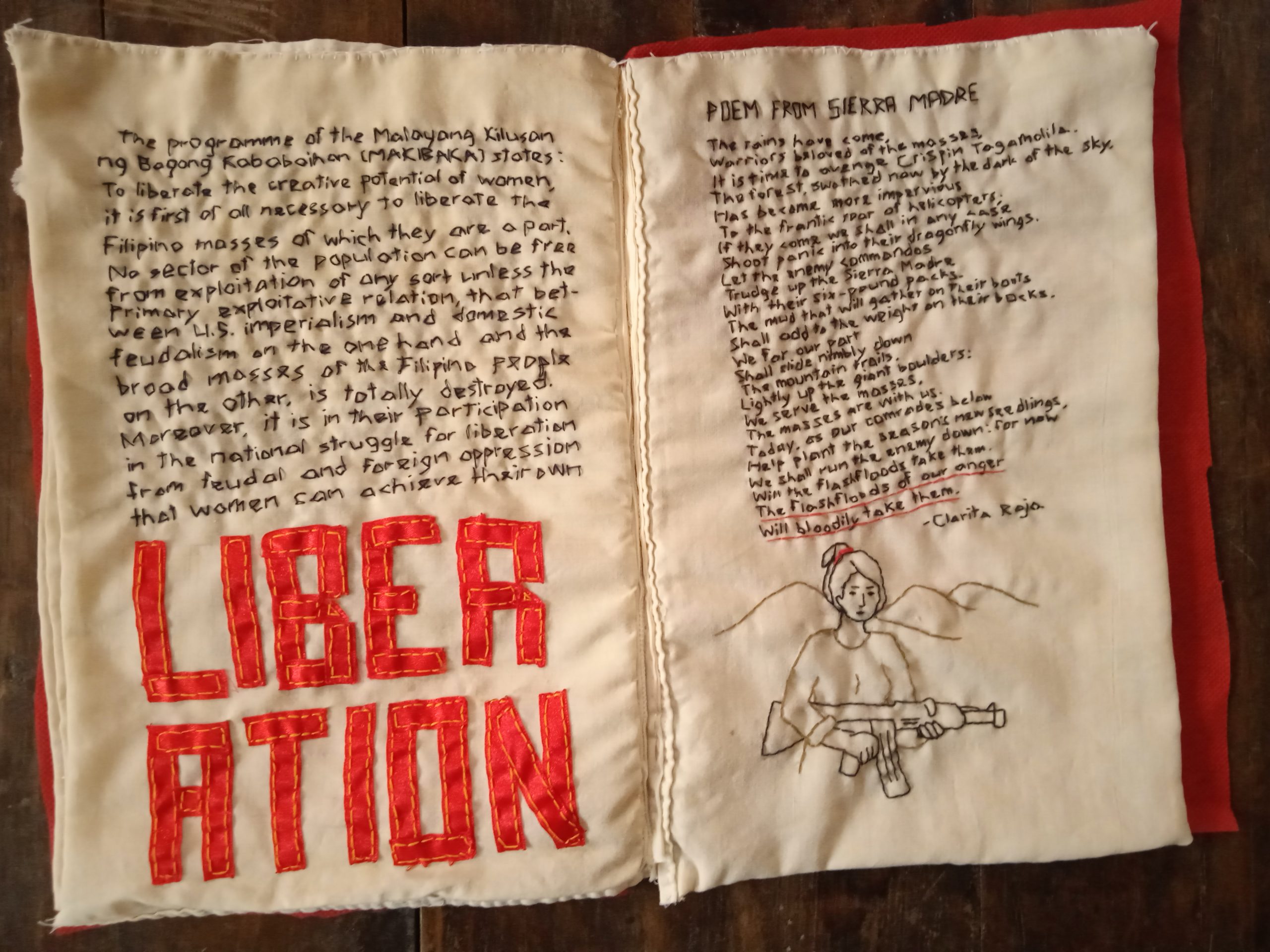
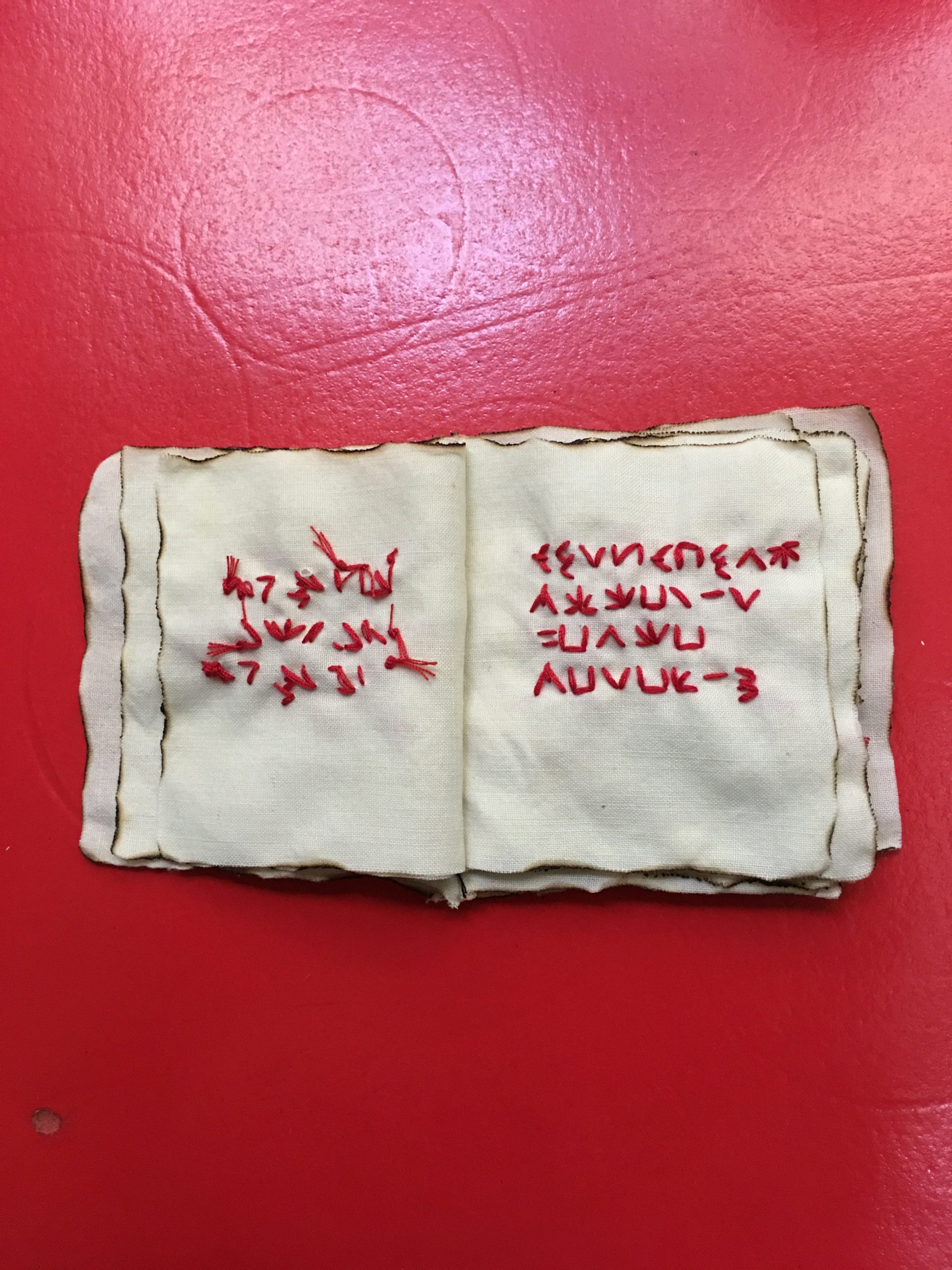
My eyes settle on Cura's pages and imagine my fingers running across the layered threads, recalling from Womanifesto's 'Gatherings' that Nitaya Ueareeworakul had also shared intricately crafted diary pages (Moments + Differences, 2021) collaged on paper made onsite, in Udonthani, as the world slowed. Also under pandemic strictures, Phaptawan Suwannakudt and Shuxia Chen wagered on a linguistic gamble which they called The Unspoken (2021), a permittedly illegible but felt conversation which left space for unknowing in the form of unraveled threads. This speculative toggling between space, time, and relational constrictions push minds and mind's eyes to winnow ways of working which cut across and outline horizons of solidarity so direly needed to date.
1 Gantala Press, 'Publishing Womanifesto v. 1', Gantala Press Blog, November 2019, https://gantalapress.org/2019/11/27/publishing-womanifesto-v-1/ (viewed June 2026)
2 ‘The plan was for the members of the collective to individually embroider texts or images from these documents onto cloth pages, which we would then bind into a book. We thought that the book could be passed down to other/younger women, who could then mend and/or add new pages or new elements. The research aspect of the project—finding texts and images to render in embroidery—would reflect the often difficult task of sifting through archives, through history, in search of women’s stories. Meanwhile, the stitchwork would imitate the multiple layers of work that women have to do: keeping things in order, mending broken things, committing things to memory, all often unpaid labor.’ Faye Cura, ‘Sewing Dissent: Making Cloth Books During COVID-19’, Social Text Online, August 4, 2021, https://socialtextjournal.org/periscope_article/sewing-dissent-making-cloth-books-during-covid-19/ (viewed March 2026).
3 See Alice Sarmiento and Rae Rival, 'Payak na dahilan / A simple reason / Một lý do giản đơn', where we are: when the storm comes?, 2020, https://whenthestormcomes314975986.wordpress.com/ruwa/ (viewed June 2026).
Related pages
Share a Reflection
log in to share a reflection.