
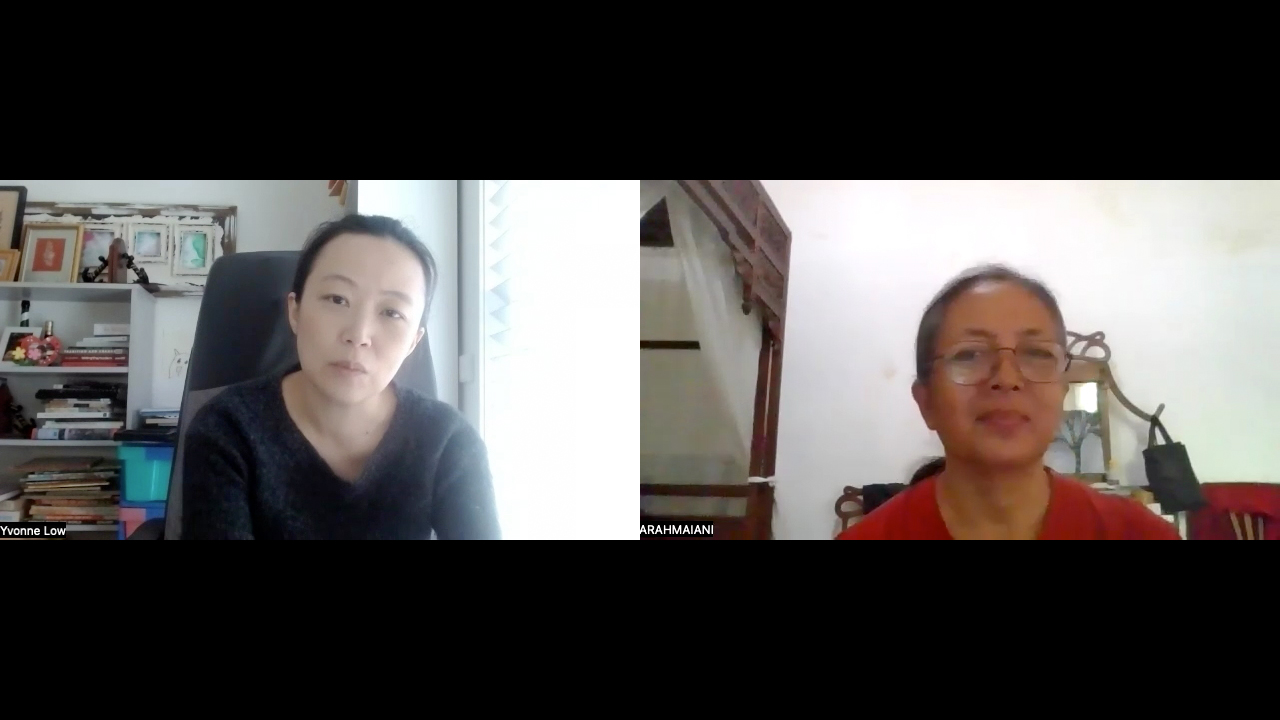
This conversation between Arahmaiani and Yvonne Low took place on the 5th of July 2023. The transcript below has been edited for publication and is accompanied by audio excerpts from the conversation. Click here to see the uncut recording.
Yvonne Low: (YL): Hello, Iani.
Arahmaiani: (A): Hello.
YL: Could you share with us how you first got to know Varsha? Nitaya?
A: Well, I think I met them when I was, having a performance in Chiang Mai. I was invited for the Chiang Mai Social Installation Festival in 1996.
YL: So that was before. Womanifesto's first exhibition?
A: Yes, Before
YL: So, Phaptawan was there or was it just Varsha and Nitaya?
A: I don't remember exactly. I think, Varsha, was there and Nitaya, also. I think Nitaya was originally from Chiang Mai.
YL: Were they participants or part of the audience
A: I don't really remember now. You can ask them. Because, you know, as a performance artist my work was quite demanding, so I was just busy with my own preparation. Also, at the beginning of the festival, the organizers said ‘oh, yeah, sorry. You cannot do that performance.’ And I said ‘Why?!’.
He said, Navin at the time was the organizer/representative, and he said, ‘oh, no, this has to do with the sacred Buddhist area, and so you cannot perform there.’ And I said, ‘why?’, and he said ‘you don't understand. You are not Buddhist.’ And I said ‘hey, come on then, you have to explain it to me because I'm not Buddhist’.
And then finally, he took me to see the, leader of the monks and the monastery. It was interesting because when I explained my idea to the head monk, he responded really nicely. We discussed things of ours, and finally he said, go ahead, you can do it. Wow, I was like ‘Yeah!’
YL:And were there other people who had similar encounters or issues as you?
A: I don't really, remember. No, but I think my work was really controversial from the beginning. But after, I got approval from the head monk, everything was fine And I remember, at one of the sites, there were some monks attending the performance too. That was quite, inspiring also for me.
YL: And, Varsha and Nitaya, they saw this work?
A: I think so, of course. Yeah.
YL: I’m just wondering, what sort of responses they might have had. Or if you remember what sort of conversations you guys had around the work.
A: Yeah, later on when I got to know Varsha and Nitaya, of course they wanted to know about the idea behind my work. And I said, ‘yes, this is something that has to do with problems in, the society I come from, which is, today mostly, considered to be Muslim, you know, but our cultural roots somehow connected also to Hinduism, to Buddhism, even animism’. That's why I try to connect myself to, that forgotten cultural heritage, especially before Islam. What I learned during that time is, the cultural strategy developed in Nusantara—the name of the Indonesian archipelago before it was called Indonesia—was actually something that was very human and very fair to everyone, because they can accept all people with, various cultural and religious backgrounds. That's why we have this so-called principle is called in, Sanskrit, language, [‘Bhinneka Tunggal Ika’] which means ‘unity in diversity’. Even when Indonesia was becoming independent and becoming Indonesia as it is today, Bhinneka Tunggal Ika was part of this kind of foundational philosophy, surrounding Indonesida’s independence. This is very important for me. But I also understood, since I used to study in the Netherlands, that the Dutch used to colonise Indonesia for about 300 years and I got to learn that the manuscripts and the artifacts from traditional culture had been looted by the colonialists. Even until today, they still like more than 10,000 artifacts in museums in the Netherlands. Manuscripts in particular, which are the source of knowledge, they still have hundreds of thousands, so you can imagine how people have lost the knowledge of their own cultural roots. This loss creates problems, this is also the reason why, hardline kinds of Islam or other religions, become active in Indonesia, because lots of people suffer this so-called ‘identity crisis’ because they don't know about who they are, because they are disconnected from the knowledge about their own culture and cultural roots.
YL: So that time in 1996, when you took part in the Chiang Mai Social Installation Festival, was it 1996, did you say? And that was when you left Indonesia. You were exiled because of your performance, right?
A: Yes. In 1994, I was, being accused of doing something blasphemous against Islam because of my artwork. It was the painting called Lingga-Yoni, and the installation piece called Etalase. Those works actually have to do with my understanding of this forgotten cultural heritage and colonization as well. Like I explained earlier, since my only time in art school was in the 80s, I was already questioning the situation in Indonesia which was supposed to be already independent. But at that time, we were under military regime, and it was really a dictatorship.
I really questioned the meaning of independence: ‘are we really already independent with this kind of situation?’ And at that time, I created a performance, which took place outdoors during the celebration of Indonesian Independence Day on the 17th of August in 1983. I created this artwork and performance, and you know what happened? I was, arrested and imprisoned. After that, I was kicked out from the art school. Anyway, that's the beginning of my struggle, and then in 1994, I had my solo exhibition in Jakarta at [ ] which included Lingga-Yoni and Etalase. That’s when I was being accused of doing something blasphemous, because they don't understand what I am trying to express.
With the Lingga-Yoni, I was actually trying to reconnect myself to this, so-called ‘local traditional wisdom’. The symbol of Lingga-Yoni is very important, and it is actually a very old symbol from the animistic time. The symbol is about the principle of balance, of oppositional power in nature, which is seen not as black and white, but in this wise way of looking at things, where there is a of connection between the black and white, and then thinking about how to balance it.
Similar to [ ], or in the middle East and they have this kind of understanding in Christianity the cross too. The original idea of balance between the vertical and horizontal, they contain similar ideas. But anyway, this, symbol of Lingga-Yoni is very interesting for me because with this symbol of phallus and vagina, it is also a symbol about fertility, life itself, physical, material aspects of life—which are not being seen as something, with and without value, because of this principle of balance. So the material aspect and the spiritual aspect has to be somehow seen in a balanced kind of position.
YL: So this work, it was shown in but Apinan, and then later in Global Feminisms. So they’re quite well-known, in that international sense, but at the time, were people aware of what you did?
A: I think, only some people, who are well educated and who understood this cultural root that had somehow been forgotten by most Indonesians at that time. But now there is a change because, when I had my solo exhibition at MACAN Museum in 2018, this work was exhibited, I was a little bit scared, a little bit worried, but it was all right.
Now it is even collected by the MACAN Museum, and it is on exhibition in the museum until October too, and no one is protesting—no one is getting angry with me. I think that this younger generation, they understand.
YL: So in terms of your discussions, what were you guys debating about? Were there any memorable exchanges that you could share with us? Moments when you disagreed about certain things regarding feminism or certain viewpoints? Can you recall any memorable incidents that stood out to you?
A: Well actually, later on, I learned about political problems in Thailand. One problem was how the minority Muslim community has been treated unfairly, and 2005 to 2006 I worked on a program, supported by Jim Thompson.
To work with Muslim and Buddhist communities, I'm becoming like a bridge, trying to connect these two groups. My aim is to build understanding because with, political strategies that try to divide and rule people. That's usually how the elite control people, by implementing so-called divide and rule politics.
Through this project, it was called 'stitching the wounds', I tried to bring these two groups together—so they can have a dialog and communicate with each other, to reduce misunderstanding between them. It was really nice, I learned a lot also from that project.
YL: Do you know that Nitaya is a Buddhist too.
A: Yeah, there's also a process of learning for me. There is something connected to Buddhism in my way of thinking. Later, when I studied in the monastery in Tibet I leaned about the heritage of Buddhism in Indonesia as well. It's very much connected, and my way of thinking is very much connected to this old ancient Buddhist philosophy. But because I am also the daughter of a religious Muslim religious leader, my late father used to be an old lama or the, an Indonesian term which is Muslim religious leader [ ]. He was also, well educated, on other cultures, his field of study was actually literature and Western culture, so got to learn about the basic principles of Islamic belief, and these principles are all very similar. These are the universal values that connect Islam, Buddhists, Hindus, whatever religion, Catholic, Christian.
I've been working with Christian and Catholic priests in Germany and I've been teaching there for more than ten years. What I learned is that the basic principles of all religion are basically the same, which is love or compassion. When you really base your lifestyle and your way of thinking on those principles you won't hate others, you won't, distrust others. But how can we live together peacefully and happily? and this is what I have learned so far, is the basic principle of all beliefs. I also realize how religion, especially after being institutionalized, can be used and manipulated for the sake of power or even for the sake of money—it is possible that that happens from time to time.
A: Well, from what I have experienced, of course, that kind of movement is very important because this is empowering the women, and giving them space to express themselves—especially with a group like Womanifesto. But there's something I developed further later on, the idea that, after empowering the women themselves, working together, supporting each other, that's actually in my practice.
I realized we also have to do something concrete, you know, not just creating artwork. For example, I have been working with communities in Indonesia, Tibet and also in Germany to empower the community of women by doing something real, doing organic gardening, for example, to provide the food for their family, the healthy food.
This really gives a sense of hope for the future because, lots of food production today is controlled by big corporations, and a lot of them are unhealthy. But, the so called green movement is also controlled by corporations and so the price of the so-called organic food is so high.
This means that people cannot really, enjoy it, especially of the middle to lower class, they cannot have it. So, with some friends, activists, woman activists, environmental activists, but also artists, I try to develop this new kind of idea and movement.
YL: This is much later, is it not?
A: Not during the 90s. Yeah, early 2000’s.
YL: Well, there are a lot of performances in the 90s. And because you were obviously one of the trailblazers.
A: Yeah, I did performances as well, but later on, when I realized this need to do concrete work, I develop performances with community too. So, I develop the kind of the so-called community-based art project, so we are doing performance together. There is one specific performance art work called Flag project, which I developed from 2006 and ongoing until today.
This is a very special kind of artwork, with the community. But, it's not just limited to performing or creating artworks, it is also dealing with concrete things like doing organic farming, managing the trash and recycling. And even in some, places like, Tibet, we were planting trees, reviving, nomadic culture and lifestyle, and then creating alternative energy system besides managing the source of water.
Related pages
Share a Reflection
log in to share a reflection.